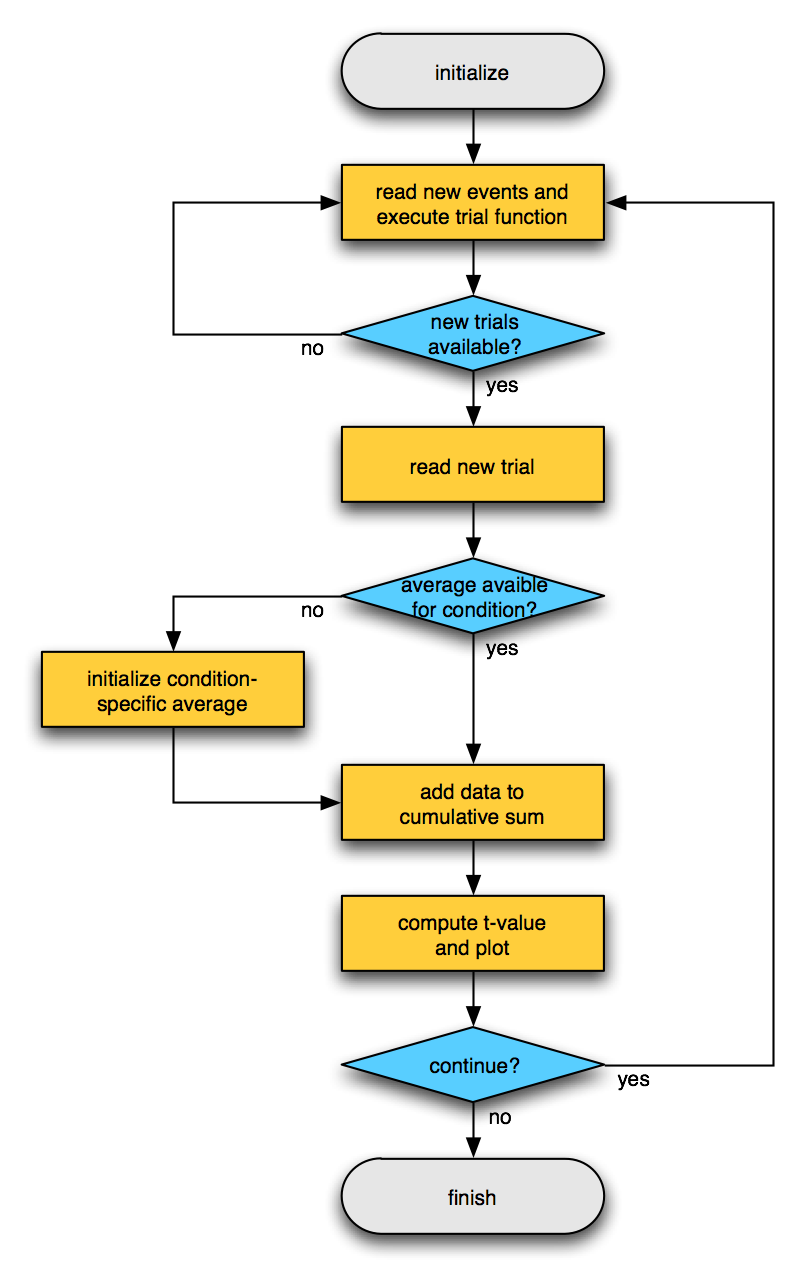
function ft_realtime_selectiveaverage(cfg) % FT_REALTIME_SELECTIVEAVERAGE is an example realtime application for online % averaging of the data. It should work both for EEG and MEG. % % Use as % ft_realtime_selectiveaverage(cfg) % with the following configuration options % cfg.channel = cell-array, see FT_CHANNELSELECTION (default = 'all') % cfg.trialfun = string with the trial function % % The source of the data is configured as % cfg.dataset = string % or alternatively to obtain more low-level control as % cfg.datafile = string % cfg.headerfile = string % cfg.eventfile = string % cfg.dataformat = string, default is determined automatic % cfg.headerformat = string, default is determined automatic % cfg.eventformat = string, default is determined automatic % % To stop the realtime function, you have to press Ctrl-C % Copyright (C) 2008, Robert Oostenveld % % Subversion does not use the Log keyword, use 'svn log <filename>' or 'svn -v log | less' to get detailled information % set the default configuration options if ~isfield(cfg, 'dataformat'), cfg.dataformat = []; end % default is detected automatically if ~isfield(cfg, 'headerformat'), cfg.headerformat = []; end % default is detected automatically if ~isfield(cfg, 'eventformat'), cfg.eventformat = []; end % default is detected automatically if ~isfield(cfg, 'channel'), cfg.channel = 'all'; end if ~isfield(cfg, 'bufferdata'), cfg.bufferdata = 'last'; end % first or last % translate dataset into datafile+headerfile cfg = ft_checkconfig(cfg, 'dataset2files', 'yes'); cfg = ft_checkconfig(cfg, 'required', {'datafile' 'headerfile'}); % ensure that the persistent variables related to caching are cleared clear read_header % start by reading the header from the realtime buffer hdr = ft_read_header(cfg.headerfile, 'cache', true); % define a subset of channels for reading cfg.channel = channelselection(cfg.channel, hdr.label); chanindx = match_str(hdr.label, cfg.channel); nchan = length(chanindx); if nchan==0 error('no channels were selected'); end prevSample = 0; count = 0; % initialize the timelock cell-array, each cell will hold the average in one condition timelock = {}; %%%%%%%%%%%%%%%%%%%%%%%%%%%%%%%%%%%%%%%%%%%%%%%%%%%%%%%%%%%%%%%%%%%%%%%%%%%%%%%% % this is the general BCI loop where realtime incoming data is handled %%%%%%%%%%%%%%%%%%%%%%%%%%%%%%%%%%%%%%%%%%%%%%%%%%%%%%%%%%%%%%%%%%%%%%%%%%%%%%%% while true % determine latest header and event information event = read_event(cfg.dataset, 'minsample', prevSample+1); % only consider events that are later than the data processed sofar hdr = read_header(cfg.dataset, 'cache', true); % the trialfun might want to use this, but it is not required cfg.event = event; % store it in the configuration, so that it can be passed on to the trialfun cfg.hdr = hdr; % store it in the configuration, so that it can be passed on to the trialfun % evaluate the trialfun, note that the trialfun should not re-read the events and header fprintf('evaluating ''%s'' based on %d events\n', cfg.trialfun, length(event)); trl = feval(cfg.trialfun, cfg); % the code below assumes that the 4th column of the trl matrix contains the condition index % set the default condition to one if no condition index was given if size(trl,2)<4 trl(:,4) = 1; end fprintf('processing %d trials\n', size(trl,1)); for trllop=1:size(trl,1) begsample = trl(trllop,1); endsample = trl(trllop,2); offset = trl(trllop,3); condition = trl(trllop,4); % remember up to where the data was read prevSample = endsample; count = count + 1; fprintf('processing segment %d from sample %d to %d, condition = %d\n', count, begsample, endsample, condition); % read data segment from buffer dat = ft_read_data(cfg.datafile, 'header', hdr, 'begsample', begsample, 'endsample', endsample, 'chanindx', chanindx, 'checkboundary', false); %%%%%%%%%%%%%%%%%%%%%%%%%%%%%%%%%%%%%%%%%%%%%%%%%%%%%%%%%%%%%%%%%%%%%%%%%%%%%%%% % from here onward it is specific to the processing of the data %%%%%%%%%%%%%%%%%%%%%%%%%%%%%%%%%%%%%%%%%%%%%%%%%%%%%%%%%%%%%%%%%%%%%%%%%%%%%%%% % put the data in a fieldtrip-like raw structure data.trial{1} = dat; data.time{1} = offset2time(offset, hdr.Fs, endsample-begsample+1); data.label = hdr.label(chanindx); data.hdr = hdr; data.fsample = hdr.Fs; % apply some preprocessing options data.trial{1} = preproc_baselinecorrect(data.trial{1}); if length(timelock)<condition || isempty(timelock{condition}) % this is the first occurence of this condition, initialize an empty timelock structure timelock{condition}.label = data.label; timelock{condition}.time = data.time{1}; timelock{condition}.avg = []; timelock{condition}.var = []; timelock{condition}.dimord = 'chan_time'; nchans = size(data.trial{1}, 1); nsamples = size(data.trial{1}, 2); % the following elements are for the cumulative computation timelock{condition}.n = 0; % number of trials timelock{condition}.s = zeros(nchans, nsamples); % sum timelock{condition}.ss = zeros(nchans, nsamples); % sum of squares end % add the new data to the accumulated data timelock{condition}.n = timelock{condition}.n + 1; timelock{condition}.s = timelock{condition}.s + data.trial{1}; timelock{condition}.ss = timelock{condition}.ss + data.trial{1}.^2; % compute the average and variance on the fly timelock{condition}.avg = timelock{condition}.s ./ timelock{condition}.n; timelock{condition}.var = (timelock{condition}.ss - (timelock{condition}.s.^2)./timelock{condition}.n) ./ (timelock{condition}.n-1); %%%%%%%%%%%%%%%%%%%%%%%%%%%%%%%%%%%%%%%%%%%%%%%%%%%%%%%%%%%%%%%%%%%%%%%%%%%%%%%% % from here onward additional processing of the selective averages could be done % as an example here the ERP of each condition is plotted in its own figure %%%%%%%%%%%%%%%%%%%%%%%%%%%%%%%%%%%%%%%%%%%%%%%%%%%%%%%%%%%%%%%%%%%%%%%%%%%%%%%% % compute the t-score versus zero by dividing the average by the standard error of mean tscore = timelock{condition}.avg ./ (sqrt(timelock{condition}.var)./(timelock{condition}.n - 1)); figure(condition) plot(timelock{condition}.time, tscore); title(sprintf('condition %d, ntrials = %d', condition, timelock{condition}.n)); % force matlab to redraw the figure drawnow end % looping over new trials end % while true
Share this page: